On this page
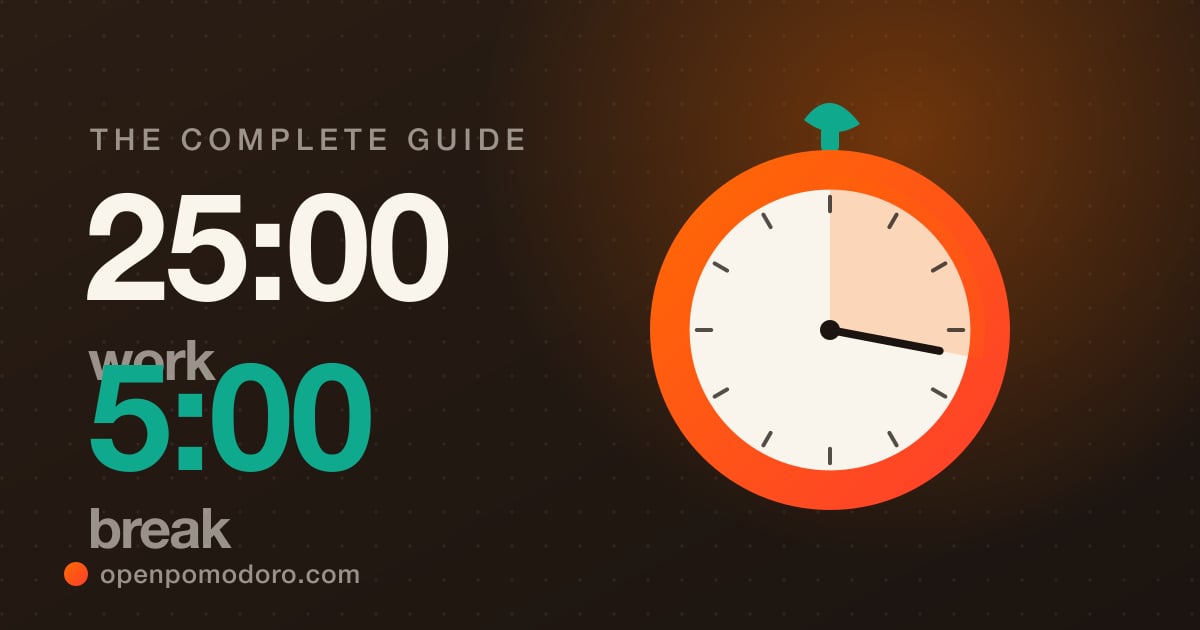
What Is the Pomodoro Technique?Where Did the Pomodoro Technique Come From?How Does the Pomodoro Technique Work?Does the Pomodoro Technique Actually Work?What Are the Real Benefits?Who Should (and Shouldn't) Use It?How to Start the Pomodoro Technique TodayWhich Interval Length Is Right for You?Common Mistakes to AvoidFrequently Asked QuestionsTry Your First Pomodoro NowThe Pomodoro Technique is a time management method where you work in focused 25-minute sessions, called pomodoros, separated by 5-minute breaks. After four pomodoros, you take a longer break of 15 to 30 minutes. Francesco Cirillo created the method in the late 1980s, naming it after the tomato-shaped kitchen timer he used as a university student.
That is the short answer. The longer answer is more interesting, because the research on fixed work intervals is genuinely mixed, and the technique helps some people far more than others.
This guide covers the full protocol step by step, the honest evidence for and against it, who benefits most, and how to run your first session today. It is the reference page for everything else on this blog.
Key Takeaways
- The Pomodoro Technique breaks work into 25-minute focus sessions separated by 5-minute breaks, with a longer 15-30 minute break after every four sessions.
- Francesco Cirillo invented the method in the late 1980s using a tomato-shaped kitchen timer; "pomodoro" means tomato in Italian.
- The evidence is nuanced: a 2025 Maastricht University trial of 94 students found fixed breaks produced no significant productivity gain over self-chosen breaks.
- Interruptions are the real enemy. Gloria Mark's UC Irvine research shows it takes about 23 minutes to fully return to a task after one.
- You can run your first session right now with this free Pomodoro timer, no signup or download required.

What Is the Pomodoro Technique?
The Pomodoro Technique is a time management method that splits work into short, timed intervals. You focus on one task for 25 minutes, rest for 5 minutes, then repeat. Every fourth session earns a longer break of 15 to 30 minutes. Each 25-minute block is called a pomodoro.
The core idea is simple: your brain sustains focus better in short, protected bursts than in long, open-ended stretches. The timer creates a container. Inside it, one task gets your full attention. Outside it, rest is not optional, it is part of the system.
Three rules make the method more than just a countdown clock. First, a pomodoro is indivisible; if you get pulled away, that session does not count. Second, you work on one task at a time, chosen before the timer starts. Third, breaks are real breaks, away from the work, not a quick scroll through email.
That indivisibility rule sounds strict, and it is. It is also the point. The technique treats attention as something worth defending, which matters more now than it did in the 1980s. According to the ActivTrak State of the Workplace 2026 report, the average focused work session now lasts just 13 minutes and 7 seconds, down 9 percent from 2023. A 25-minute protected block nearly doubles that.
Where Did the Pomodoro Technique Come From?
Francesco Cirillo created the Pomodoro Technique in the late 1980s while struggling to study as a university student in Italy. He grabbed a tomato-shaped kitchen timer from his kitchen, wound it to a few minutes, and challenged himself to focus until it rang. "Pomodoro" is the Italian word for tomato, and the name stuck.
Cirillo's early experiments were humble. He started with just two minutes of committed focus, then stretched the interval as his concentration improved. Over years of refinement, he settled on 25 minutes as the sweet spot: long enough to make real progress, short enough that starting never feels intimidating.
He later formalized the method into a full system with planning, tracking, and review stages, described on his official site. The technique spread through software teams in the 2000s, then exploded with the rise of productivity apps. Today the Wikipedia entry on the Pomodoro Technique lists dozens of variations, and tomato timers appear in nearly every to-do app on the market.
One detail often gets lost in retellings: Cirillo designed the method around a physical, mechanical timer on purpose. The act of winding it was a small ritual of commitment, and the ticking was a constant reminder to stay on task. Modern digital timers drop the ticking, but the ritual of deliberately starting a session still matters.
How Does the Pomodoro Technique Work?
The Pomodoro Technique works through a six-step loop: pick one task, set a timer for 25 minutes, work until it rings, take a 5-minute break, and repeat. After four pomodoros, you take a longer break of 15 to 30 minutes. Interruptions are logged and deferred, not obeyed.
Here is the full protocol as Cirillo designed it.
Step 1: Choose One Task
Before the timer starts, decide exactly what you will work on. Not a category like "emails" but a specific outcome: "reply to the three client emails from Monday." Write it down. Vague intentions are where focus sessions go to die.
Step 2: Set the Timer for 25 Minutes
Start a 25-minute countdown. A kitchen timer works, a phone works, or use a purpose-built online Pomodoro timer that tracks your sessions automatically. The moment the timer starts, the pomodoro begins and the task gets your full attention.
Step 3: Work Until the Timer Rings
Focus on that single task and nothing else. If a stray thought or to-do pops up, jot it on a piece of paper and return to work. Do not check your phone, do not switch tabs, do not "quickly" answer a message. The session ends when the timer says so, not before.
Step 4: Handle Interruptions With the Inform, Negotiate, Call Back Method
Cirillo built a specific defense for interruptions. When someone needs you mid-pomodoro, inform them you are in the middle of something, negotiate a time to follow up, then call them back as promised during a break. Log the interruption with a small mark on your task sheet.
If the interruption is truly urgent, a fire alarm rather than a Slack ping, abandon the pomodoro and start fresh later. A broken pomodoro does not count. That rule sounds harsh, but it trains you to treat sessions as commitments rather than suggestions. In my own sessions, simply telling a colleague "give me 15 minutes" resolves nine out of ten interruptions with zero friction.
Step 5: Take a Real 5-Minute Break
When the timer rings, stop, even mid-sentence. Stand up, stretch, get water, look out a window. The break should rest the same mental muscles you just used, so avoid screens where possible. Checking email during a break is not a break; it is a task switch wearing a disguise.
Step 6: Repeat, Then Take a Long Break After Four Pomodoros
After four completed pomodoros, take a longer break of 15 to 30 minutes. Eat something, take a walk, let your mind fully disengage. Then start the next set. Cirillo also recommends tracking completed pomodoros per task, which turns fuzzy questions like "how long do reports take me?" into hard data within a week or two.
Does the Pomodoro Technique Actually Work?
Honestly, the evidence is mixed, and anyone telling you otherwise is selling something. The strongest recent study found no productivity advantage for fixed Pomodoro-style breaks over self-chosen breaks. What the research does support is the technique's value as a defense against interruptions and a cure for procrastination on hard-to-start tasks.
Let's look at the actual studies rather than the hype.

The Maastricht Trial: No Magic in Fixed Breaks
A 2025 randomized controlled trial at Maastricht University, run by Smits and Wenzel and published in an MDPI journal, tested 94 students. One group took fixed Pomodoro-style breaks; the other took breaks whenever they chose. The result: no significant difference in productivity between the groups. Interestingly, fatigue built faster under the fixed schedule, suggesting mandatory breaks at rigid intervals may interrupt people who were doing fine.
So if you already regulate your energy well, forcing a break every 25 minutes may cost you more than it gives. That finding deserves to be taken seriously, and we cover the failure cases in detail in when the Pomodoro Technique doesn't work.
The Interruption Research: Where the Technique Earns Its Keep
Here is the other side of the ledger. Gloria Mark's research at UC Irvine found it takes an average of 23 minutes and 15 seconds to fully return to a task after an interruption (Mark et al., CHI 2008). One "quick question" from a colleague can quietly erase half an hour of momentum.
Now scale that up. The Microsoft Work Trend Index 2025 found knowledge workers face roughly 275 interruptions per day, about one every two minutes during core hours (Microsoft WorkLab). Combine those two numbers and the modern workday starts to look like a machine designed to prevent deep work. We break down that math fully in why you can't focus.
Against that backdrop, the Pomodoro Technique is less a productivity hack and more a treaty you sign with your environment: for 25 minutes, nothing gets in. The research suggests that is precisely where its value lies. The timer does not make you work faster. It makes interruptions wait.
The Honest Verdict
The technique is not magic, and the 25-minute number is not sacred. What works is the underlying structure: a single task, a protected interval, a genuine rest, and a system for deferring interruptions. Whether the interval is 25 minutes or 52 is a personal calibration question, which we will get to shortly.
What Are the Real Benefits?
The Pomodoro Technique delivers three benefits the research and practitioner experience consistently support: it lowers the barrier to starting dreaded tasks, it builds accurate time awareness through tracking, and it gives you a script for deflecting the interruptions that cost knowledge workers 23 minutes of refocus time each (Mark et al., 2008).
It Solves the Starting Problem
Procrastination is rarely about laziness. It is about a task feeling too big or too unpleasant to begin. "Write the report" is intimidating. "Work on the report for 25 minutes" is not. The timer shrinks the commitment to something your brain will accept, and once you have started, momentum usually carries you further than the first session.
Students feel this benefit most sharply, which is why the method is a staple of exam preparation. Our guide to the Pomodoro Technique for studying covers how to pair sessions with active recall and spaced repetition.
It Builds Time Awareness
Most people are terrible at estimating how long work takes. Tracking pomodoros fixes that fast. After two weeks of logging, you know that a blog post takes you six pomodoros and a code review takes two. Planning stops being guesswork.
This tracking layer also pairs naturally with calendar-based planning. If you already block your day into chunks, the Pomodoro and time blocking hybrid approach lets the timer handle execution while the calendar handles strategy.
It Gives You an Interruption Defense
The inform-negotiate-callback script from Step 4 may be the most underrated part of the whole system. Without a script, every ping gets answered instantly. With one, most interruptions turn out to be perfectly happy waiting 15 minutes. Given Microsoft's finding of roughly 275 daily interruptions per knowledge worker, a repeatable deflection habit compounds quickly.
Who Should (and Shouldn't) Use It?
The Pomodoro Technique fits best for procrastinators, students, people in interruption-heavy environments, and anyone whose focus muscle has atrophied. It fits worst for people who reach deep flow states easily, since a rigid 25-minute alarm can shatter exactly the concentration the method is meant to build.
Strong Fits
- Chronic procrastinators. The 25-minute commitment defeats the starting problem better than almost any other method. If starting is your main battle, read why you procrastinate and how to stop.
- Students. Bounded sessions map neatly onto reading, problem sets, and revision, and breaks aid memory consolidation.
- People in noisy workplaces. The timer plus the interruption script creates structure where the environment provides none.
- Anyone rebuilding focus. If your attention span has shrunk to the 13-minute average ActivTrak measured, 25-minute reps are training.
Poor Fits
- Deep flow workers. If you regularly sink into two-hour creative or analytical trances, an alarm at minute 25 is sabotage, not support.
- Meeting-heavy schedules. When your calendar is diced into 30-minute fragments, there is often no room to run clean sessions.
- Highly self-regulated workers. The Maastricht trial suggests people who already take breaks intuitively gain little from a fixed schedule, and may fatigue faster.
Programmers sit in an interesting middle ground: the work rewards flow, but the context-switching cost of losing it is brutal. Many settle on longer intervals, and our Pomodoro for developers guide makes the case for a 50/10 protocol that respects compile-and-think rhythms.
If you have tried the classic method and bounced off it, that is data, not failure. The troubleshooting guide walks through the common failure modes and what to adjust before abandoning timed work entirely.
How to Start the Pomodoro Technique Today
Starting takes under two minutes: write down one specific task, open the free Pomodoro timer, press start, and work until the bell. No account, no download, no reading required. The only real preparation worth doing is silencing notifications before your first session begins.
Here is a simple first-day plan.
- Pick a task you have been avoiding. The technique shines brightest against procrastination, so give it a worthy opponent.
- Clear the obvious interruption sources. Phone on silent and face down, notifications paused, one browser window.
- Run four pomodoros with proper breaks. Two in the morning and two after lunch is a perfectly respectable start. Do not attempt twelve on day one.
- Keep a scrap of paper beside you. Every stray thought, urge, or remembered errand gets written down and dealt with during a break.
- Review at the end of the day. How many sessions did you complete? What broke the others? That log is your improvement roadmap.
Expect the first few sessions to feel strangely long. That is normal, and it is diagnostic: it shows how rarely your attention gets 25 uninterrupted minutes. Most people find sessions start feeling short within a week.
Resist the urge to optimize on day one. Run the classic 25/5 protocol for at least a week before changing interval lengths, adding apps, or customizing anything. You need a baseline before you can tune.
Which Interval Length Is Right for You?
Start with the classic 25/5, then adjust based on how you feel at the bell. If the alarm consistently interrupts genuine flow, lengthen the interval. Research offers several candidates: a 2014 DeskTime study found top performers worked in 52-minute sessions with 17-minute breaks, while Nathaniel Kleitman's work points to natural 90-minute alertness cycles.
The evidence for longer intervals is worth knowing. DeskTime's 2021 re-run found top performers had shifted further, to 112 minutes of work with 26-minute breaks. K. Anders Ericsson's landmark 1993 study in Psychological Review found elite violinists practiced in roughly 90-minute sessions and rarely exceeded 4.5 hours of deliberate practice per day. Kleitman's basic rest-activity cycle suggests alertness naturally rises and falls on a roughly 90-minute ultradian rhythm.
In my own 50-minute sessions, the difference shows up in the type of work: writing thrives on the longer block, while administrative tasks feel better in classic 25s. Matching interval to task type beats picking one universal number.
The practical takeaway: 25 minutes is a starting dose, not a prescription. For a full comparison of the 25/5, 52/17, 50/10, and 90-minute protocols, including how to test which suits you, see our guide to Pomodoro interval variations.
Common Mistakes to Avoid
The most damaging mistakes are treating breaks as optional, scrolling your phone during them, running vague tasks, and counting interrupted sessions as complete. Each one quietly removes the mechanism that makes the technique work, which is why people often blame the method when the implementation was the problem.
The big four in brief:
- Skipping breaks. Powering through the bell feels productive but burns the recovery the next session depends on.
- Phone breaks. Five minutes of social media is stimulation, not rest. Your attention returns more tired than it left.
- Vague task definitions. "Work on the project" invites drift. Name a concrete outcome before every session.
- Counting broken pomodoros. If a session shattered at minute 12, log it as broken. Honest data is the whole value of tracking.
There are seven recurring failure patterns in total, including some subtle ones around long breaks and multitasking within a session. We dissect all of them, with fixes, in 7 common Pomodoro mistakes.
Frequently Asked Questions
How long is one pomodoro?
One pomodoro is 25 minutes of focused work on a single task, followed by a 5-minute break. The 25-minute length is Francesco Cirillo's original specification, refined through years of self-experimentation. After four pomodoros, the protocol calls for a longer break of 15 to 30 minutes before starting the next set.
What should I do during the 5-minute break?
Rest the mental muscles you just used. Stand up, stretch, refill your water, look out a window, or step outside briefly. Avoid email, news, and social media, since those are attention tasks in disguise. The goal is genuine recovery, so that the next session starts with something close to a fresh mind.
Can I change the 25-minute interval?
Yes, and many people should. Cirillo's 25 minutes is a starting point, not a law. Developers often prefer 50/10, DeskTime's research supports 52/17, and deep creative work may suit 90-minute blocks aligned with natural ultradian rhythms. Run the classic version for a week first, then experiment using our interval variations guide.
Does the Pomodoro Technique work for ADHD?
Many people with ADHD find it helpful, because externalizing time into a visible countdown compensates for time blindness, and the short commitment eases task initiation. Results vary, though, and rigid intervals can clash with hyperfocus. Treat the protocol as adjustable: shorter sessions, more frequent breaks, and visual timers are common adaptations worth testing. Our Pomodoro for ADHD guide covers the modified protocols in detail.
What happens if I get interrupted mid-pomodoro?
Use Cirillo's inform, negotiate, call back method: tell the person you are mid-task, agree on a follow-up time, and honor it during your break. Log the interruption. If the matter genuinely cannot wait, abandon the session and restart later; a broken pomodoro does not count. Most interruptions can comfortably wait 15 minutes.
Do I need a special app or timer?
No. Cirillo used a mechanical kitchen timer, and any countdown works. A dedicated tool helps mainly with tracking and long-break scheduling, which are easy to neglect manually. Our free online Pomodoro timer runs in the browser with no signup, handles the 25/5/long-break cycle automatically, and lets you customize interval lengths.
How many pomodoros should I aim for in a day?
Eight to twelve completed pomodoros is a strong day for most knowledge workers, which is four to six hours of genuine focus. That aligns with Ericsson's 1993 finding that even elite performers rarely exceeded 4.5 hours of deliberate practice daily. Beginners should start with four and build up gradually.
Try Your First Pomodoro Now
Reading about focus does not build it. One completed session teaches you more about the Pomodoro Technique than this entire guide, and it costs 25 minutes you were probably going to spend half-distracted anyway.
Pick one task you have been putting off. Silence your phone. Then open the free Pomodoro timer at OpenPomodoro, press start, and work until the bell rings. Take the break. See how it felt.
When you are ready to go deeper, the guides linked throughout this page cover studying, coding, interval tuning, and the mistakes that trip up beginners. You can also branch out into Pomodoro vs Flowtime, staying focused while working from home, deep work vs shallow work, and break ideas that actually recharge you. Start with the timer, though. The technique only works once you do.
Put this article into practice
Run your next focus session with our free online Pomodoro timer. No signup, fully adjustable intervals, works right in your browser.