On this page
What Makes a Good Pomodoro Break?10 Ideas for 5-Minute Breaks10 Ideas for 15-30 Minute Long Breaks5 Break Activities That BackfireHow to Actually Return from a BreakFrequently Asked QuestionsThe timer rings. Break time. You grab your phone, just to glance at one notification, and somehow five minutes becomes twenty-five. A good Pomodoro break does three things: it puts your body in a different state than work, it opens no new mental tabs, and it ends the moment the timer calls you back.
Your phone fails all three tests. It keeps you in the same chair, floods your head with new threads, and never wants to let you go. That's not a break. That's a trap wearing a break's clothes.
This post gives you 25 specific pomodoro break ideas, sorted by break length, plus the five activities that quietly sabotage your next work session. Bookmark it, then steal from it daily.
Key Takeaways
- The best breaks are physical, low-input, and easy to exit.
- Micro-breaks reliably reduce fatigue; breaks longer than 10 minutes help performance on demanding tasks (Albulescu et al., 2022).
- Phone scrolling is a task switch, not a break. Refocusing after a real switch takes about 23 minutes (Gloria Mark, UC Irvine).
- Short breaks: move, hydrate, reset your eyes. Long breaks: walk, nap, eat away from your desk.
- Run your sessions with this free Pomodoro timer so break length never depends on willpower.
What Makes a Good Pomodoro Break?
A good Pomodoro break restores energy without starting anything new. A 2022 PLOS ONE meta-analysis of micro-break research found that short breaks reliably improve well-being and reduce fatigue, while performance gains show up more clearly when breaks stretch past 10 minutes on demanding tasks (Albulescu et al., 2022). Recovery is the whole job.
Think of breaks as pit stops. Nobody wins a race by skipping them, and nobody wins by letting the pit crew scroll Instagram while the tires wait. You pull in, you refuel, you get out. Fast, deliberate, repeatable.
So run every break idea through three filters. Is it physically different from work? Sitting and staring at a second screen fails. Does it open new cognitive threads? An email or a news headline plants a thought that follows you back to your desk. Is it easy to exit? A stretch ends on its own. A TikTok feed never does.
A break that leaves you more tired than the work defeats the point.
The phone deserves special mention. Gloria Mark's research at UC Irvine found it takes about 23 minutes and 15 seconds to fully refocus after a real interruption (Mark et al., 2008). Scrolling isn't rest, it's a context switch, and you pay for it long after the break ends. If your attention already feels shredded most days, that mechanism is a big part of why you can't focus.
New to the method itself? Start with our complete guide to how the Pomodoro Technique works, then come back for the break menu.
10 Ideas for 5-Minute Breaks
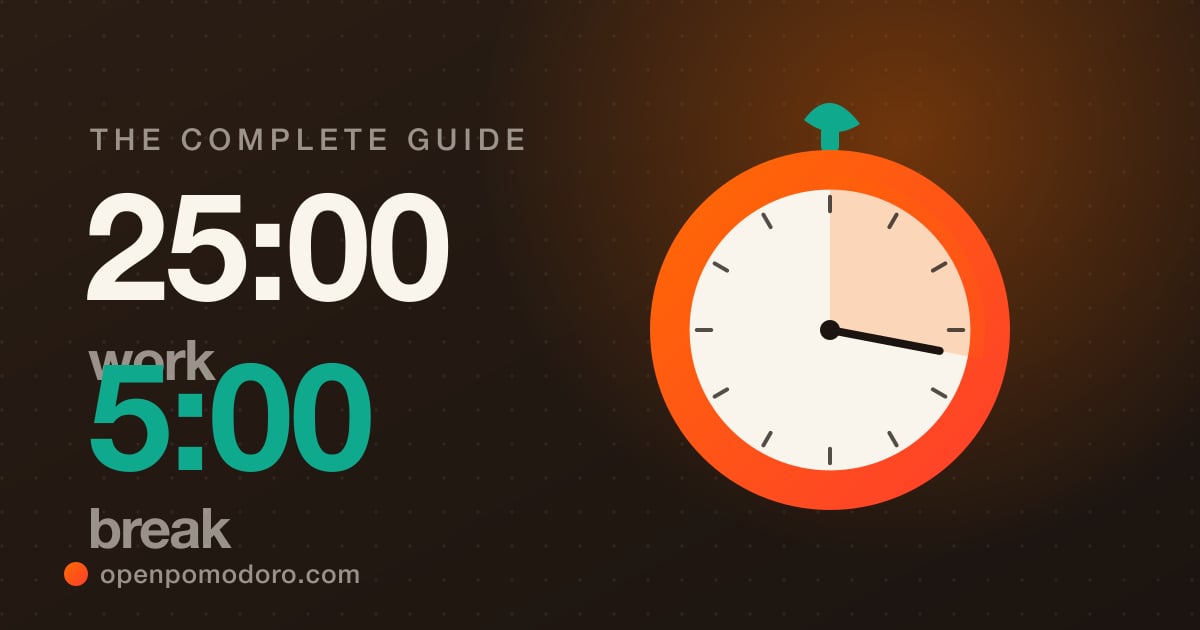
Five minutes is short, so the best pomodoro break ideas here are physical, single-step, and phone-free. The classic protocol from Francesco Cirillo, developed in the late 1980s, pairs 25 minutes of focus with a 5-minute break (Francesco Cirillo). Treat those five minutes as a body reset, not a content snack.
If your body hasn't moved, your break hasn't started.
1. Stretch the muscles your desk ignores
Roll your shoulders backward ten times, then tilt your ear toward each shoulder for 20 seconds. Your neck and traps absorb most of your sitting posture. Give them the first minute of every break.
2. Climb a flight of stairs
Up and down twice gets your heart rate above desk level in under two minutes. No stairs? Twenty slow squats next to your chair do the same job.
3. Do the doorway posture reset
Stand in a doorway, place your forearms on the frame, and lean gently forward for 30 seconds. It opens the chest that hunches shut during typing. You'll feel taller walking back to your desk.
4. Run the 20-20-20 eye reset
Look at something 20 feet away for 20 seconds. Optometry associations widely recommend this every 20 minutes of screen time, which makes the end of a pomodoro perfect timing. Do it at a window and you get daylight as a bonus.
5. Try 4-7-8 breathing
Inhale through your nose for 4 counts, hold for 7, exhale slowly for 8. Four rounds takes about two minutes. It's the fastest way to downshift a racing head between sessions.
6. Refill your water and actually drink it
Walking to the kitchen is the movement. Drinking a full glass before you sit back down is the part most people skip. Both halves count.
7. Tidy one surface
One surface, not the whole room. Clear the desk corner, stack the papers, return the three mugs. A five-minute tidy has a built-in finish line, which makes it easy to exit.
8. Write one journal line
Grab a notebook and finish this sentence: "Next pomodoro, the one thing that matters is..." One line, no more. It doubles as your re-entry cue later.
9. Pet the dog
Or the cat, or lean out the window and watch the neighbor's dog. Sixty seconds of animal attention asks nothing of your prefrontal cortex, which is exactly the point.
10. Stand outside for the full five
No task, no phone, just outside air. Temperature change and natural light are a stronger state shift than anything you can do indoors. Rain counts. Rain might even count double.
10 Ideas for 15-30 Minute Long Breaks
Long breaks are where real recovery happens. The Albulescu meta-analysis found performance benefits strengthen when breaks run longer than 10 minutes on demanding tasks (Albulescu et al., 2022), and the classic protocol schedules a 15 to 30 minute long break after every fourth pomodoro (Wikipedia). Spend these like you mean it.
11. Walk around the block
Outside, one loop, no earbuds required. Walking clears the mental cache better than any app. If you work from home, this is the commute your brain misses; it pairs well with the routines in our guide to Pomodoro for remote work.
12. Eat a real meal away from your desk
Different room, real plate, no screen. Eating at your desk teaches your brain that the desk is for everything, which means it's for nothing in particular.
13. Take a shower
Twenty minutes, total state change, and famously where stuck problems come loose. In my experience, the idea that refused to arrive during pomodoro three shows up around minute four of the shower.
14. Power nap under 20 minutes
Set an alarm for 20 minutes and lie down, eyes closed, even if you don't sleep. Keep it under 20 so you skip deep sleep and wake without grogginess.
15. Run a full stretching routine
Five minutes buys you a neck roll. Twenty buys hips, hamstrings, and spine, the areas that make afternoon sitting miserable. Follow any basic mobility video, or just work top to bottom.
16. Call a friend
Voice, not text. A 15-minute call is social recovery that ends cleanly when the timer rings. Texting, by contrast, trickles on for hours.
17. Prep tomorrow's food
Chop vegetables, portion lunch, marinate something. Your hands work, your work-brain rests, and future-you eats better. Three wins from one break.
18. Knock out one quick errand
Mail the package, pick up the prescription, water the plants. One errand, chosen before the break starts, so you're not deciding on the fly.
19. Practice an instrument
Twenty minutes of scales or one song. Music demands just enough attention to fully evict work thoughts, without creating new open loops.
20. Do absolutely nothing
Sit somewhere comfortable and stare at the wall or the sky. No input, no output. It feels wrong for the first three minutes, and then your mind starts wandering somewhere useful.
Boredom is not a failure state. It's your brain defragmenting.
Want different work-to-break ratios entirely, like 50/10 or 90/20? See our breakdown of Pomodoro interval variations to match break length to your session length.
5 Break Activities That Backfire
Some breaks cost more than they give. Gloria Mark's interruption research suggests why: a genuine context switch takes roughly 23 minutes to recover from (Mark et al., 2008), so a five-minute "break" that switches your context can quietly tax the whole next pomodoro. These five are the usual suspects.
Anything with an algorithm is not a break. It's a second job.
21. Doomscrolling
The feed is engineered to be un-exitable, so it fails the easy-exit test by design. Worse, it loads your head with fresh emotional threads that follow you back to work.
22. Starting "just one" episode
Episodes are 22 to 60 minutes and end on cliffhangers. You cannot fit one inside a break, and your brain knows it, which is exactly why it suggests the idea.
23. The quick email check
One unread message becomes an obligation, a draft reply, and a background worry. You've swapped your task for someone else's. This one is common enough that it headlines our list of common Pomodoro mistakes.
24. News rabbit holes
One headline links to three more, and none of them resolve in five minutes. You return to your desk informed, alarmed, and completely unfocused.
25. Online snack-shopping
Browsing counts as decisions, and decisions are precisely what you're resting from. Comparing two brands of trail mix uses the same mental machinery as comparing two paragraphs.
How to Actually Return from a Break
The return matters as much as the break itself. A 2025 randomized controlled trial at Maastricht University with 94 students compared fixed Pomodoro-style breaks against self-chosen ones and found no productivity difference, though fatigue built faster under the rigid schedule (Smits and Wenzel, 2025). Translation: taking breaks seriously beats obsessing over exact timing.
So build a re-entry ritual with three parts. Same chair: return to the exact spot you left, because place is a memory cue. Same task cue: reread the one-line journal note from idea number 8, or the last sentence you wrote. Timer first: start the next pomodoro on your timer before your brain opens negotiations about "just checking one thing."
Start the timer before your brain starts negotiating.
The ritual takes 15 seconds. It works because it removes every decision from the transition, and decisions are where breaks go to die.
Frequently Asked Questions
What should I do during a 5-minute Pomodoro break?
Pick something physical with a natural end point: stretch your neck and shoulders, climb stairs, run the 20-20-20 eye reset, drink a full glass of water, or step outside. Avoid anything with a feed or an inbox. The goal is a body-state change that ends cleanly when the timer rings, not entertainment.
Is it OK to use my phone during Pomodoro breaks?
It's legal, but it's a bad trade. Gloria Mark's UC Irvine research found refocusing after a genuine context switch takes about 23 minutes, and a phone break is a context switch in disguise. If you must touch the phone, do one closed-loop action, like sending a single reply, then put it face down in another room.
How long should a Pomodoro long break be?
The classic protocol calls for 15 to 30 minutes after every fourth pomodoro, alongside the standard 25/5 rhythm Francesco Cirillo designed in the late 1980s. Research supports the longer end for hard work: the Albulescu et al. (2022) meta-analysis found performance benefits are stronger for breaks over 10 minutes on demanding tasks.
Should I skip breaks when I'm in flow?
Occasionally, sure, but don't make it your default. The 2025 Maastricht trial (Smits and Wenzel) found fatigue built faster under rigid fixed breaks, so finishing a thought before pausing is fine. Skipping breaks for hours, though, is how you end up exhausted by 2 p.m. Flow now often means fog later.
Do Pomodoro breaks actually work, according to research?
Yes, with nuance. The Albulescu et al. (2022) PLOS ONE meta-analysis found micro-breaks reliably improve well-being and reduce fatigue, while performance gains favor longer breaks on demanding tasks. The 2025 Maastricht trial adds that exact timing matters less than actually taking breaks. Consistency beats precision.
What if 5 minutes never feels like enough?
Then change the ratio instead of skipping breaks. Longer sessions like 50/10 or 90/20 pair deeper focus blocks with breaks long enough for a real walk. Our guide to Pomodoro interval variations covers how to pick a rhythm that fits your work, and any decent timer lets you customize both lengths.
Here's your homework, and it's the fun kind. Pick one new break idea from this list each day this week: stairs on Monday, the doorway reset on Tuesday, the do-nothing break on Wednesday. Seven days, seven experiments, and you'll know exactly which breaks recharge you and which ones you were only taking out of habit.
Run the whole thing with the free Pomodoro timer. It handles the clock so you can spend your breaks actually breaking.
Put this article into practice
Run your next focus session with our free online Pomodoro timer. No signup, fully adjustable intervals, works right in your browser.