On this page
What's the Difference Between Pomodoro and Flowtime?How Does the Pomodoro Technique Work?How Does the Flowtime Technique Work?What Does the Research Say?Pomodoro vs Flowtime: Head-to-Head ComparisonWhich Should You Choose?Frequently Asked QuestionsTry Both This WeekNeither method wins outright, and anyone who claims otherwise is oversimplifying. The honest answer: the Pomodoro Technique works better for tasks you resist and for people still building focus stamina, while the Flowtime Technique wins for deep, creative work once you can self-regulate. Your task type and your discipline pick the winner, not the method.
That's not a cop-out. A 2025 randomized controlled trial at Maastricht University (Smits & Wenzel, 94 students) compared fixed Pomodoro-style breaks against self-chosen breaks and found no significant productivity difference between the two, though fatigue built faster under the fixed schedule.
So the real question isn't "which is better?" It's "which is better for the work sitting in front of you right now?" This comparison answers exactly that.
Key Takeaways
- The Pomodoro Technique imposes fixed 25/5 intervals; the Flowtime Technique lets you work until focus naturally fades, then rest proportionally.
- A 2025 Maastricht University trial found no productivity gap between fixed and self-regulated breaks, but fixed schedules increased fatigue faster.
- Choose Pomodoro for dreaded tasks and weak self-regulation; choose Flowtime for deep, creative work.
- A hybrid works well: Pomodoro to start your day, Flowtime once you're warmed up.
- You can run either method with the same free Pomodoro timer, using countdown mode or the stopwatch.

What's the Difference Between Pomodoro and Flowtime?
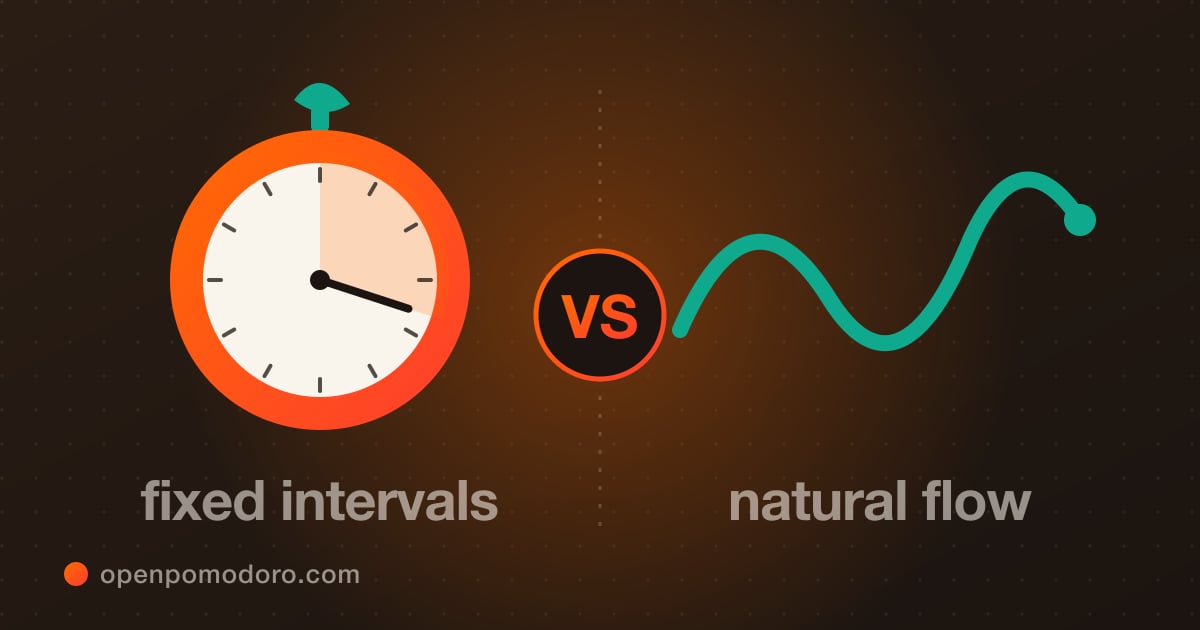
The Pomodoro Technique uses fixed intervals: 25 minutes of work, 5 minutes of rest, with a timer deciding when you stop. The Flowtime Technique flips that. You work until your focus naturally fades, then rest in proportion to how long you worked. One imposes structure from outside; the other follows your attention.
Think of it as interval training versus a long run by feel. Pomodoro is the interval session: fixed sprints, fixed recovery, and the whistle blows whether you feel fresh or not. Flowtime is the long run: you keep going while your legs feel good and slow down when they don't. Both build fitness. They just suit different runners on different days.
The core trade-off is simple: Pomodoro protects you from yourself, while Flowtime protects your flow.
Here's what that looks like in practice. If you're avoiding your tax paperwork, a 25-minute commitment feels survivable, so Pomodoro gets you started. If you're a designer 40 minutes into a logo concept and the ideas are finally flowing, a ringing timer is the last thing you need, so Flowtime keeps you in the pocket.
Each method suits a different person too. Pomodoro fits beginners, procrastinators, and anyone whose "quick break" tends to become an hour of scrolling. Flowtime fits experienced deep workers who can honestly tell the difference between fading focus and mild discomfort.
How Does the Pomodoro Technique Work?
Francesco Cirillo created the Pomodoro Technique in the late 1980s, naming it after his tomato-shaped kitchen timer. The classic pattern: pick one task, work for 25 minutes, take a 5-minute break, and take a longer break after four cycles. The timer is the boss, not your mood.
That external structure is the whole point. You don't negotiate with yourself about when to stop or start. You just answer the bell. For a full walkthrough of the rules, the mindset, and the common mistakes, read our complete guide to how the Pomodoro Technique works.
The 25/5 split isn't sacred, either. Cirillo's original method uses it as a default, but plenty of people run 50/10 or 90/20 instead. We cover those options in our guide to Pomodoro interval variations.
Pomodoro's superpower is lowering the cost of starting. Twenty-five minutes is small enough that your brain stops arguing. That's why it shines on the tasks you keep postponing: the expense report, the inbox purge, the essay you've rewritten the first sentence of six times.
How Does the Flowtime Technique Work?
The Flowtime Technique, created by Zoë Read-Bivens under the name "Flowmodoro," replaces the fixed timer with a log. You write down your start time, work on one task until your focus genuinely fades, write down your stop time, then take a break proportional to how long you worked. Then you repeat.
Read-Bivens designed it as a direct response to Pomodoro's biggest flaw: the timer interrupts you at minute 25 even when you're doing your best work of the day. Flowtime keeps Pomodoro's discipline, one task at a time with real breaks, but hands the stopping decision back to you.
Here's the full loop in practice:
- Pick one task. Same rule as Pomodoro: no multitasking.
- Log your start time. A notebook, a spreadsheet, or a stopwatch works.
- Work until your focus fades. Not until you're bored for ten seconds. Until your attention genuinely drops and errors creep in.
- Log your stop time. Now you know exactly how long you focused.
- Take a proportional break. A common rule of thumb: about 5 minutes of rest for every 25 minutes worked. Worked 75 minutes? Take around 15.
- Repeat, and review your logs at the end of the day.
The log matters more than it looks. After a week, you'll see your real focus patterns: maybe you reliably hit 50-minute stretches in the morning and barely manage 20 after lunch. Flowtime doesn't just manage your attention, it measures it.
One warning from my own experience: the first week of Flowtime is humbling. Most people discover their "natural focus session" is shorter than they assumed, and that's useful data, not failure.
What Does the Research Say?
The most direct evidence comes from a 2025 randomized controlled trial at Maastricht University (Smits & Wenzel, published in an MDPI journal, 94 students). Fixed Pomodoro-style breaks produced no significant productivity difference compared with self-regulated breaks. Fatigue, however, built faster under the fixed schedule. Neither method dominated; the fixed rhythm simply cost more energy.
Read that carefully, because both camps like to skip it. Pomodoro fans can't claim the timer boosts output, and Flowtime fans can't claim rigid breaks tank it. Output was a wash. The fatigue finding is the interesting part: being interrupted on someone else's schedule appears to wear you down faster than resting when you actually need to.
Flow research points the same direction. Mihaly Csikszentmihalyi, who spent decades studying flow states, found they require uninterrupted engagement and take time to enter. A timer that fires every 25 minutes can act like a wall between you and your deepest work.
Interruptions carry a second cost. Sophie Leroy's 2009 research in Organizational Behavior and Human Decision Processes identified "attention residue": when you switch away from an unfinished task, part of your mind stays stuck on it. Gloria Mark's research at UC Irvine adds a number to the pain, finding it takes about 23 minutes and 15 seconds to fully refocus after an interruption.
There's a biological angle too. Nathaniel Kleitman's basic rest-activity cycle suggests our alertness runs in roughly 90-minute ultradian rhythms. Many Flowtime users find their natural sessions land in the 60-to-90-minute range, which fits that pattern far better than a 25-minute box does.
The research verdict: fixed timers don't make you more productive, but they do make starting easier, and that's the trade you're actually weighing.
Pomodoro vs Flowtime: Head-to-Head Comparison
Neither method sweeps the board. Pomodoro wins on structure, beginner-friendliness, and distraction defense, because the timer makes every decision for you. Flowtime wins on flow protection, fatigue management, and fit for deep work, because you rest when your body asks instead of when a bell rings. The table below shows where each one earns its keep.
| Dimension | Pomodoro Technique | Flowtime Technique |
|---|---|---|
| Structure | Fixed 25/5 cycles, timer-enforced | Self-directed, log-based sessions |
| Flow protection | Weak: timer can cut flow at minute 25 | Strong: you stop only when focus fades |
| Beginner-friendliness | High: clear rules, nothing to judge | Moderate: requires honest self-assessment |
| Best task types | Dreaded chores, admin, studying, email | Writing, coding, design, deep analysis |
| Fatigue management | Fixed breaks; fatigue built faster in the 2025 Maastricht trial | Proportional breaks matched to actual effort |
| Tracking overhead | Low: the timer counts for you | Higher: you log start and stop times yourself |
| Distraction defense | Strong: "I'll check that after this Pomodoro" | Weaker: no bell holding you accountable |
A quick gut-check for reading this table: picture a developer mid-refactor, holding the whole dependency chain in her head. The Pomodoro bell at minute 25 doesn't just pause her work; per Leroy's attention residue research, it scatters the mental model she spent 20 minutes building. For her, Flowtime is the obvious call. We dig into that exact scenario in Pomodoro for developers.
Now picture the same developer facing a task she hates: writing documentation. No flow state is coming. Here the bell isn't a threat, it's a lifeline, and Pomodoro wins in a walk.
Which Should You Choose?
Choose based on two factors: task type and self-regulation skill. Pick the Pomodoro Technique for shallow, resisted, or fragmented work and for building focus habits from scratch. Pick the Flowtime Technique for deep, creative work once you can reliably tell fading focus from momentary boredom. Most people eventually need both.
Here's the decision framework, question by question.
Is the task deep or shallow?
Deep work, the kind that needs a loaded mental model, favors Flowtime. Shallow work favors Pomodoro, where interruptions cost little and momentum matters more than depth. If you're unsure which kind you're facing, our breakdown of deep work vs shallow work draws the line clearly.
Are you avoiding the task?
If yes, use Pomodoro. Resistance means you need a small, non-negotiable starting ritual, and "just 25 minutes" is the most reliable one ever invented. Flowtime asks you to work until focus fades, but on a dreaded task your focus fades at minute two, which gives you a permission slip to quit.
Can you actually self-regulate?
Be honest here. If your five-minute breaks have a habit of becoming forty, Flowtime's freedom will hurt you, and Pomodoro's bell is your friend. In my experience coaching myself through both, self-regulation is a skill you earn through weeks of practice, not a personality trait you either have or don't.
The hybrid most people land on
Run Pomodoro for your first hour to break the morning's inertia, then switch to Flowtime once you're warm and a big task has its hooks in you. Use the timer to start and your attention to finish. If classic Pomodoro has repeatedly failed you, it may be a fit problem rather than a discipline problem; see when the Pomodoro Technique doesn't work.

Frequently Asked Questions
Is Flowtime better than Pomodoro?
No, not universally. The 2025 Maastricht University trial (Smits & Wenzel) found no significant productivity difference between fixed and self-regulated breaks, though fatigue rose faster on the fixed schedule. Flowtime is better for deep, creative work and experienced focusers. Pomodoro is better for resisted tasks and for anyone still building self-regulation.
How long should a Flowtime break be?
Make it proportional to the work session. A common rule of thumb is about 5 minutes of rest per 25 minutes of focused work, so a 50-minute session earns roughly 10 minutes and a 75-minute session earns about 15. The point is matching recovery to effort instead of taking identical breaks after wildly different sessions.
Who created the Flowtime Technique?
Zoë Read-Bivens created it, originally calling it "Flowmodoro." She designed it as a fix for the Pomodoro Technique's main weakness: the timer interrupts you even when you're in a productive flow state. Her version keeps single-tasking and deliberate breaks but replaces the fixed 25-minute countdown with logged start and stop times.
Does the Pomodoro Technique kill flow state?
It can. Mihaly Csikszentmihalyi's research shows flow requires uninterrupted engagement and takes time to enter, and a bell every 25 minutes can cut you off right as you get there. Longer intervals like 50/10 or 90/20 reduce the damage while keeping the structure. Many deep workers keep Pomodoro but stretch the work blocks.
Can I use a Pomodoro timer app for Flowtime?
Yes. For Pomodoro, run the countdown as usual. For Flowtime, use stopwatch or count-up mode to log how long you worked, then set a short countdown for your proportional break. One tool covers both methods, so switching between them costs nothing and you can experiment freely for a week before committing.
What if my focus fades after only 10 minutes?
That's normal early on, and it's exactly what Flowtime's log is for. Record the honest number, take a short break, and start again. If your sessions stay tiny for weeks, switch to Pomodoro temporarily; the fixed 25-minute container trains focus stamina the way intervals train a runner before longer distances.
Try Both This Week
Run a simple experiment: Pomodoro on Monday through Wednesday, Flowtime on Thursday and Friday, notes on energy and output each day. Five days of your own data beats any productivity article, including this one. The free timer at Open Pomodoro handles both, countdown mode for Pomodoro and stopwatch mode for Flowtime, so the only thing left to test is you.
Put this article into practice
Run your next focus session with our free online Pomodoro timer. No signup, fully adjustable intervals, works right in your browser.