On this page
How Long Should a Pomodoro Be?Who Should Use the Classic 25/5 Interval?The 50/10 Protocol for Deep WorkWhat Does the 52/17 Rule Get Right?The 90-Minute Ultradian BlockWhen Do Short Intervals Like 15/3 Work Best?Which Interval Fits Your Work?How to Test Your Ideal Interval in One WeekFrequently Asked QuestionsFind Your Interval This WeekA pomodoro should be 25 minutes with a 5-minute break if you are just starting out. That is the classic protocol Francesco Cirillo built in the late 1980s, with a longer 15 to 30 minute break every four rounds. But 25 minutes is a starting point, not a law. Intervals from 10 to 90 minutes all work when they match your task and energy.
The evidence backs that flexibility. DeskTime's 2014 study found its most productive users worked 52-minute sessions, while Nathaniel Kleitman's research shows human alertness cycles in roughly 90-minute rhythms. Different tasks and different brains reward different numbers.
This guide compares the major pomodoro interval variations, shows the research behind each, and gives you a one-week protocol to find your own. New to the method? Start with the complete Pomodoro Technique guide, then come back here to tune your numbers.
Key Takeaways
- Francesco Cirillo's classic Pomodoro Technique uses 25 minutes of work, a 5-minute break, and a longer 15 to 30 minute break every four rounds.
- DeskTime's 2014 study found the most productive 10% of users worked 52-minute sessions with 17-minute breaks; its 2021 re-run showed top performers stretching to 112 minutes.
- A 2025 Maastricht University trial of 94 students found fixed Pomodoro breaks no more productive than self-chosen breaks, so the best interval is the one you actually keep.
- Ninety-minute blocks align with Nathaniel Kleitman's ultradian rest-activity cycle and the roughly 90-minute practice sessions in K. Anders Ericsson's 1993 study of elite violinists.
- You can test every interval in this article with the free Pomodoro timer, which lets you adjust both work and break lengths.

How Long Should a Pomodoro Be?
A pomodoro should be as long as you can sustain full attention on one task, which for most people falls between 25 and 90 minutes. A 2025 randomized controlled trial at Maastricht University (Smits and Wenzel, 94 students) found fixed Pomodoro-style breaks produced no significant productivity difference versus self-regulated breaks. Structure matters more than the exact number.
That finding is liberating. You do not need to hunt for one magic duration. You need a repeatable rhythm of protected focus and genuine rest, then you adjust the lengths until the rhythm holds.
Why does the protected part matter so much? Research by Gloria Mark at UC Irvine found it takes about 23 minutes and 15 seconds to fully refocus after an interruption. A single ping can erase an entire short pomodoro. Any interval you defend beats a perfect interval you abandon, and if defending focus is your real struggle, read why you can't focus first.
Who Should Use the Classic 25/5 Interval?
The classic 25/5 interval serves beginners, people with task anxiety, and anyone doing fragmented administrative work. Twenty-five minutes is short enough that starting feels easy, yet long enough to finish an email batch, a reading section, or a small ticket. Francesco Cirillo designed it precisely for that low barrier to entry.
Cirillo developed the method in the late 1980s using a tomato-shaped kitchen timer, which is where the Pomodoro Technique gets its name. The full protocol adds a longer break of 15 to 30 minutes after every fourth pomodoro, which keeps the day sustainable.
Students often stay with 25/5 permanently because revision, flashcards, and problem sets slice neatly into 25-minute units. Our guide to the Pomodoro Technique for studying covers how to pair intervals with specific study methods.
Where 25/5 struggles is deep, continuous work. If you code, write, or design, the timer often rings just as you finally load the whole problem into your head. That is your cue to try longer variations.
The 50/10 Protocol for Deep Work
The 50/10 protocol suits deep work on tasks you already understand: writing a planned chapter, building a scoped feature, working through a defined analysis. Fifty minutes gives you time to reach real depth, and it halves the number of context switches compared with 25/5, which matters when refocusing carries a cost of roughly 23 minutes per interruption in Gloria Mark's research.
Two classic pomodoros merge into one, and the two 5-minute breaks merge into a single 10-minute break that is long enough to actually rest. Walk, stretch, refill water, look out a window. Screens on breaks tend to defeat the purpose.
Developers adopted this variation widely because compilation-heavy, architecture-heavy work punishes frequent stops. We break down the workflow, including how to handle interruptions from teammates, in our guide to the Pomodoro Technique for developers.
One caution: 50 minutes of genuine focus is demanding. If you notice yourself drifting at minute 35, do not force it. Drop back to 25/5 for that task rather than training yourself to sit distracted with a timer running.
What Does the 52/17 Rule Get Right?
The 52/17 rule captures a real pattern in workplace data: intense work paired with generous, real breaks. DeskTime's 2014 productivity study found the most productive 10% of its users worked in 52-minute sessions followed by 17-minute breaks. They did not work more hours than everyone else. They worked with more intensity, then stepped fully away.
Seventeen minutes sounds indulgent next to the classic 5. Yet that length is exactly what makes the sprint sustainable, because a 17-minute break allows a proper walk, a meal prep, or a real conversation rather than a quick scroll.
Interestingly, the numbers moved. DeskTime's 2021 re-run of the study found top performers had shifted to 112 minutes of work with 26-minute breaks during the remote-work era. Fewer office interruptions apparently let focused sessions run much longer.
Treat both findings as observational, not causal. DeskTime measured what its most productive users did, not what made them productive. Still, the underlying ratio, roughly three parts work to one part real rest, is a solid template for office days.
The 90-Minute Ultradian Block
Ninety-minute blocks suit creative and strategic deep work, and they rest on real physiology. Sleep researcher Nathaniel Kleitman found that human alertness naturally cycles in roughly 90-minute ultradian rhythms, a pattern known as the basic rest-activity cycle. Working with that wave, then resting as it dips, aligns your schedule with your biology.
Elite performers appear to converge on the same number. K. Anders Ericsson's 1993 study in Psychological Review found top violinists practiced in sessions of about 90 minutes and rarely exceeded 4.5 hours of deliberate practice per day. Full-intensity focus is a limited daily resource, and 90-minute blocks spend it in large, deliberate units.
Match the break to the effort. After 90 minutes of hard thinking, take 20 to 30 minutes fully away from the desk. Two or three such blocks is a genuinely productive day; do not schedule six.
Reserve this variation for your hardest work and your best hours. Running a 90-minute block on shallow email is a waste, and running one at 4 p.m. on low sleep usually collapses into browsing.
When Do Short Intervals Like 15/3 Work Best?
Short intervals, 15/3 or even 10/2, work best on low-energy days, for dreaded tasks, and for people with ADHD who find 25 minutes intimidating. There is a case for meeting your attention where it actually is: ActivTrak's State of the Workplace 2026 report puts the average focused work session at just 13 minutes and 7 seconds, down 9% from 2023.
Seen that way, a 15-minute pomodoro is not a downgrade. It is a realistic container that turns "I can't face this" into "I can do ten minutes." Momentum usually follows, and you can lengthen intervals once you are moving.
In my own experience, 10/2 is the single best tool for tax paperwork and inbox archaeology, the tasks I would otherwise defer for weeks. Two or three tiny rounds in, resistance fades and I quietly switch the timer back to 25.
Short intervals also make a good diagnostic. If even 10 focused minutes feels impossible, the interval is not your problem. Our article on when the Pomodoro Technique doesn't work covers the deeper blockers and what to do about them.
Which Interval Fits Your Work?
No single interval wins overall, and the Maastricht trial's null result is the proof: fixed 25/5 breaks beat nothing, but they did not beat self-chosen structures. The winning move is matching the interval to three things, your task type, your current energy, and your experience with timed focus.
Here is the full comparison at a glance:
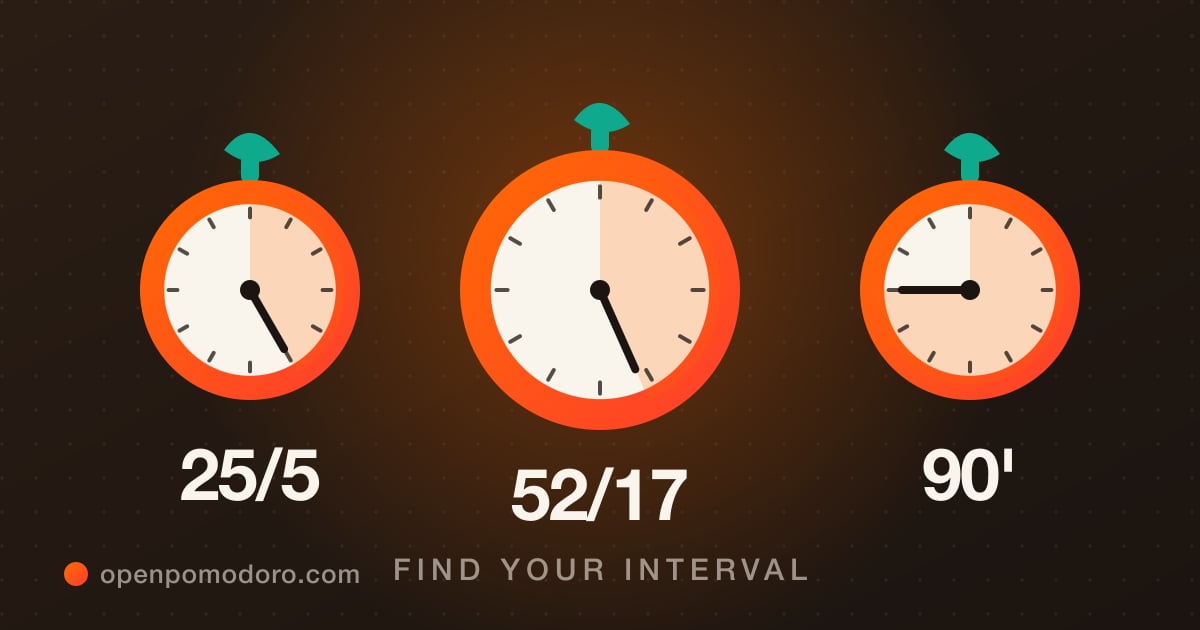
| Interval | Work | Break | Best for | Evidence |
|---|---|---|---|---|
| 10/2 | 10 min | 2 min | Dreaded tasks, very low energy, getting unstuck | Practitioner-reported; consistent with Maastricht 2025 finding that fit beats formula |
| 15/3 | 15 min | 3 min | ADHD, low-energy days, rebuilding a focus habit | ActivTrak 2026: average focus session is 13 min 7 s, so 15 min matches real attention spans |
| 25/5 | 25 min | 5 min | Beginners, admin work, studying, task anxiety | Francesco Cirillo's original protocol, refined since the late 1980s |
| 50/10 | 50 min | 10 min | Deep work on well-defined tasks, coding, writing | Halves context switches; Gloria Mark measured ~23 min to refocus after interruptions |
| 52/17 | 52 min | 17 min | Sustained office productivity across a full day | DeskTime 2014 study of its most productive 10% of users |
| 90/20 | 90 min | 20-30 min | Creative and strategic deep work, hard problems | Kleitman's ultradian rhythm research; Ericsson 1993 elite-practice sessions of ~90 min |

A few quick decision rules make the table practical:
- By task: shallow or fragmented work favors 25/5 and below; deep, continuous work favors 50/10 and above.
- By energy: tired days call for shorter intervals, not heroic ones. Save 90-minute blocks for your peak hours.
- By experience: earn your way up. Run 25/5 consistently for two weeks before attempting 50/10, and 50/10 before 90/20.
How to Test Your Ideal Interval in One Week
You can find your best interval with a five-day self-experiment: hold your tasks roughly constant, change only the interval, and score each day. This mirrors what the research supports, since the Maastricht trial suggests personal fit, not a universal number, drives the benefit.
The protocol looks like this:
- Monday and Tuesday: baseline at 25/5. Log how many pomodoros you complete and rate your focus from 1 to 5 at the end of each day.
- Wednesday: 50/10. Use it on your two deepest tasks. Note where in the interval your attention faded, if it did.
- Thursday: 52/17. Copy the DeskTime pattern, including the full 17-minute break away from screens.
- Friday: 90/20 in the morning, 15/3 in the afternoon. One ultradian block on your hardest problem, then short rounds for the shallow leftovers.
Score each configuration on output, focus quality, and how you felt at 6 p.m. That last measure matters; an interval that produces great Tuesdays and exhausted Wednesdays loses.
When I ran this experiment myself, the surprise was not the winner but the split: 50/10 for morning writing, 15/3 for afternoon admin. Expect a portfolio of intervals rather than a single answer.
Frequently Asked Questions
Is 25 minutes the best pomodoro length?
No single length is best. Twenty-five minutes is Francesco Cirillo's original recommendation and the ideal starting point, but a 2025 Maastricht University trial of 94 students found fixed Pomodoro breaks no more productive than self-regulated ones. Start at 25/5, then lengthen or shorten based on your task type and where your attention actually fades.
What is the 52/17 rule?
The 52/17 rule comes from DeskTime's 2014 study, which found the most productive 10% of its users worked in 52-minute sessions with 17-minute breaks. The pattern combines intense, undistracted work with breaks long enough for real recovery. DeskTime's 2021 follow-up found top remote-era performers had stretched to 112-minute sessions with 26-minute breaks.
How long should pomodoro breaks be?
Scale the break to the work. Classic 25-minute pomodoros pair with 5-minute breaks plus a 15 to 30 minute long break every four rounds. Fifty-minute sessions earn about 10 minutes, DeskTime's 52-minute sprinters rested 17, and a 90-minute deep block deserves 20 to 30 minutes fully away from your desk.
Should I use a different pomodoro length for studying?
Usually the classic 25/5 works best for studying, because flashcards, reading sections, and problem sets divide naturally into 25-minute units, and frequent breaks aid memory consolidation. For deep tasks like essay drafts or exam-level problem solving, try 50/10. Our guide to the Pomodoro Technique for studying matches intervals to specific study methods.
How many pomodoros should I do per day?
Count focused hours, not pomodoros. K. Anders Ericsson's 1993 research found elite violinists rarely exceeded 4.5 hours of deliberate practice per day, working in roughly 90-minute sessions. That translates to about ten classic pomodoros, five 50/10 rounds, or three 90-minute blocks of genuinely hard work. Fill the rest of the day with lighter tasks.
What if the timer keeps interrupting my flow?
Lengthen the interval before abandoning the method. If 25 minutes cuts you off mid-thought, move to 50/10 or a 90-minute block so the bell arrives at a natural seam. Gloria Mark's UC Irvine research shows refocusing after any interruption takes about 23 minutes, so fewer, longer intervals often protect flow better than frequent short ones.
Find Your Interval This Week
The research points one direction: the best pomodoro length is the one that fits your task, your energy, and your habits well enough to survive a bad Tuesday. Cirillo's 25/5 remains the smartest default, DeskTime's 52/17 earns its reputation for office days, and 90-minute ultradian blocks are unmatched for hard creative work.
So run the one-week experiment. The free Pomodoro timer at Open Pomodoro has fully adjustable work and break intervals, so you can move from 10/2 to 90/20 in two clicks. Test your best length this week, keep the scores honest, and let your own data pick the winner.
Put this article into practice
Run your next focus session with our free online Pomodoro timer. No signup, fully adjustable intervals, works right in your browser.